
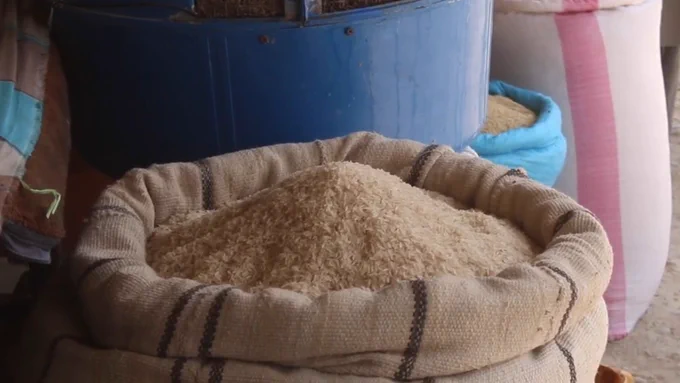
The price of rice, a primary food staple for Afghan families, has almost doubled in the last year and a half, significantly increasing economic pressure on a population already facing a severe humanitarian crisis.
Data from the World Food Programme (WFP) indicates that the price for one kilogram of rice, which was approximately 65 Afghanis in March 2025 (Hoot 1403), has now surged to around 120 Afghanis. This follows a peak a few months ago when the price per kilogram reached 143 Afghanis.
A key factor behind this dramatic increase has been the recurring closure of border crossings with Pakistan due to tensions with the Taliban government. Pakistan has traditionally been a major supplier of rice to Afghanistan, and disruptions to this trade route have a direct impact on market prices. For instance, when Islamabad fully closed the crossings in October 2025 (Mizan 1404), the price stood at 98 Afghanis.
Interestingly, there is a stark discrepancy with WFP's own weekly data, which suggests a much smaller price hike. According to those weekly reports, the price for lower-quality 'shola' rice increased by only 13 Afghanis, and high-quality 'palaw' rice by 24 Afghanis over the same period.
A joint report by WFP and the REACH initiative notes that while Afghan traders have shifted trade flows towards alternative routes through Iran and Central Asian countries, these new routes are longer and incur higher transportation costs.
This situation has negatively impacted not only consumers but also Afghan producers and traders who traditionally relied on Pakistani markets for their exports. As this trend continues, the economic strain on households is expected to intensify, especially with winter approaching.
Source: World Food Programme
🌐
