
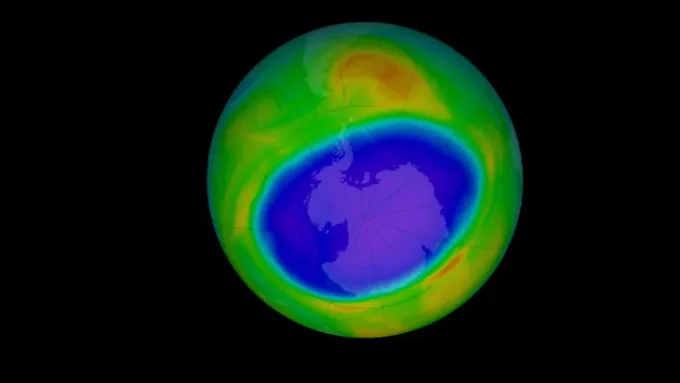
The ozone hole over Antarctica expanded to become the seventh largest in nearly five decades of satellite monitoring, according to data released by NASA and the National Oceanic and Atmospheric Administration. Measurements showed the hole reached a peak extent of approximately 10.5 million square miles in September 2026.
Despite the significant size, scientists explained that the long-term recovery of the Earth's protective layer remains on track. Researchers attributed this expansion primarily to unusual atmospheric patterns rather than a setback in global environmental recovery efforts.
The hole reached its maximum area on September 18, 2026, spanning 27.1 million square kilometres across the polar region. During the peak period of depletion between September 7 and October 13, the average area was measured at roughly 9.6 million square miles.
A powerful polar vortex was identified as a primary cause of the heightened depletion. This wind system trapped frigid air over Antarctica, facilitating the formation of polar stratospheric clouds that trigger chemical reactions destructive to ozone when spring sunlight emerges.
NOAA measurements indicated that ozone density over the South Pole fell to a low of 105 Dobson units on October 17. This remains higher than the historic record low of 92 Dobson units documented in October 2006.
Scientists noted that without the 1987 Montreal Protocol, which phased out damaging chlorofluorocarbons, the 2026 hole would have been an additional 1 to 2 million square miles larger. Complete recovery to 1980 levels is anticipated around 2066.
Source: NASA / NOAA
🌐
