
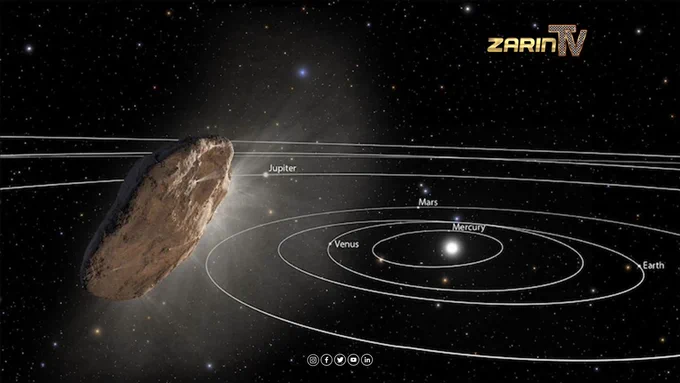
Scientists claim that Oumuamua, the first interstellar object discovered in October 2017, is a fragment of an icy exoplanet from outside our solar system.
Steve Desch, a researcher at Arizona State University, says the object resembles Pluto’s surface and is composed mostly of nitrogen ice.
Unlike typical comets, Oumuamua lacks rocky or carbon-rich material and has a more elongated shape.
Researchers believe this object is a piece of an “exo-Pluto” that was ejected from the surface of an icy dwarf planet through violent collisions.
Simulations show that most material scraped from these Pluto-like objects was nitrogen. Jupiter’s gravity likely flung many of these objects into interstellar space.
This discovery suggests that Pluto-like fragments are abundant throughout the galaxy. Desch states: “These objects are much harder to find, but there are a lot more of them”.
Future surveys by Pan-STARRS, ATLAS, and Vera Rubin Observatory will help scientists learn more about distant dwarf planets.
