
How religion, history, and geopolitics shape the tensions surrounding Jerusalem, Iran, Israel, and the United States
In the world of politics, wars are often described as struggles over territory, resources, or strategic influence. Governments form alliances, armies move across borders, and analysts speak about national security and regional balance. Yet beneath these familiar explanations lies another powerful force that shapes how people understand conflict. That force is belief.
Throughout history, religion and identity have influenced how societies interpret war, power, and destiny. In moments of geopolitical tension, especially in the Middle East, these deeper narratives sometimes rise to the surface.
Today, as tensions between the United States, Iran, and Israel periodically intensify, some observers believe the crisis cannot be understood solely through the language of diplomacy or military strategy. They argue that elements of religious belief and apocalyptic interpretation also shape how certain communities view these events.
Jerusalem as the spiritual center
At the center of many of these discussions stands one city. Jerusalem.
Few places on earth hold the same spiritual weight. For billions of people across the world, Jerusalem is not simply a political capital or historic city. It is sacred ground.
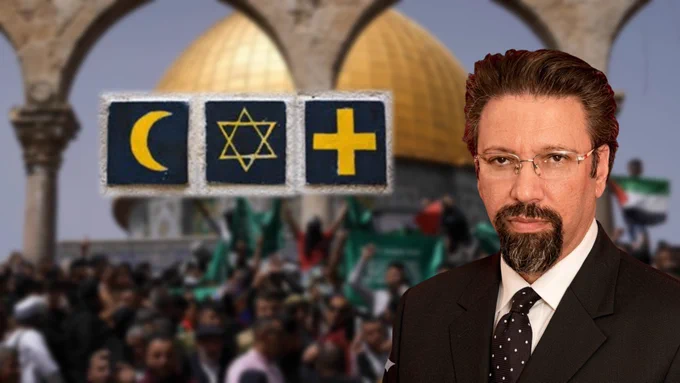
One of the most important landmarks in Jerusalem is the Dome of the Rock, located within the Al Aqsa compound. In Islamic tradition, this is the place from which the Prophet Muhammad, peace be upon him, is believed to have ascended to heaven during the Night Journey. Because of this belief, the site holds immense spiritual significance for Muslims.
For Jews, the same area is also deeply sacred. Many believe it is the location where the ancient Temple of Solomon once stood. For centuries this place has symbolized spiritual identity, historical memory, and religious devotion.
Because of these layered meanings, the site is not only a religious location but also one of the most politically sensitive places in the world.
Prophecy and modern politics
For some religious communities, events in the Middle East are interpreted through the lens of prophecy.
Among certain Christian groups, particularly within segments of evangelical Christianity, there is a strong belief in the return of Jesus Christ. This belief is often referred to as the Second Coming. According to some interpretations of Christian scripture, the return of Christ may be preceded by a period of global upheaval, conflict, and transformation. For believers who hold this view, developments in the Middle East sometimes appear connected to these prophecies.
Judaism also contains a powerful messianic tradition. Many Jews believe that a future Messiah will one day emerge as a divinely guided leader who will establish justice and peace in the world. In many interpretations of this belief, Jerusalem again holds a central role.
These expectations do not necessarily determine political decisions, but they can influence how individuals and communities understand unfolding events.
A conflict shaped by identity
Some analysts argue that religious narratives contribute to the ideological framing of tensions in the region.
Israel defines itself as a Jewish state. Iran often presents itself as a defender of parts of the Islamic world. The United States remains Israel’s most important strategic ally.
Because of this dynamic, some observers interpret regional crises not only as geopolitical competition but also as part of a broader confrontation involving religion and identity.
Yet this interpretation is far from universally accepted.
The political reality
Many scholars of international relations emphasize that the main roots of conflict in the Middle East are political and strategic.
Regional influence, national security, economic interests, and power competition remain the primary drivers of most conflicts. According to this perspective, religion is often used to mobilize public support, strengthen national identity, or frame political narratives rather than serving as the fundamental cause of war.
In other words, belief can shape how conflicts are explained without necessarily being the reason they begin.
Where history, faith, and power intersect
What makes the Middle East unique is the way history, religion, and politics intertwine.
In this region, sacred geography, ancient traditions, modern nationalism, and global diplomacy exist side by side. A single location, decision, or event can carry meaning that stretches across centuries of memory and belief.
Because of this complexity, conflicts in the region cannot be understood through one perspective alone. Political strategy, cultural identity, historical memory, and religious meaning all play a role.
The responsibility of leadership
In a world where military technology has become increasingly destructive, the stakes of conflict are higher than ever.
The challenge for leaders today is to prevent sacred beliefs from becoming tools of war. Religious traditions have the power to inspire compassion, justice, and reconciliation. Yet when intertwined with political struggle, they can also deepen division.
The future of the region may depend not only on diplomacy and political agreements, but also on the ability of leaders and communities to ensure that religious differences do not become the spark for destructive conflict.
Noor Wodjouatt
