
Sometimes I ask myself a simple question:
Why is it that in Afghanistan, leaders make the decisions, but ordinary people pay the price?
A leader stages a coup, but young Afghans die.
A leader starts a war, but ordinary families lose their homes.
One leader fights another for power, but it is the people who are forced to flee.
A leader makes a mistake, but sometimes generations are left paying for it.
Perhaps this is one of the most painful realities of Afghanistan’s history.
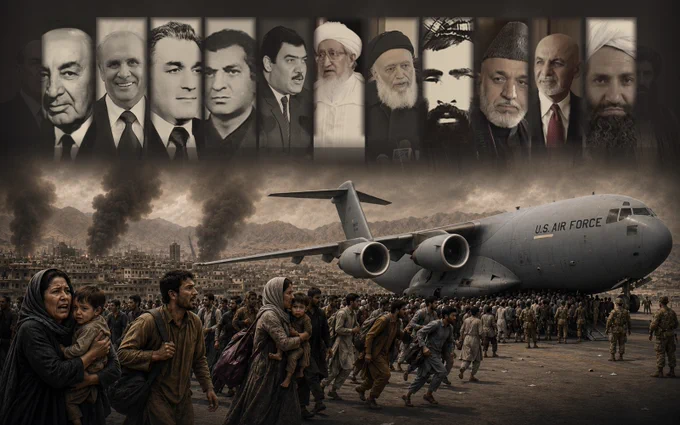
When we read Afghan history, we mostly encounter the names of leaders: Amanullah Khan, Zahir Shah, Daoud Khan, Taraki, Amin, Karmal, Najibullah, the Mujahideen leaders, the Taliban, Karzai, and Ghani.
But among all these names, one is too often forgotten:
The people.
They did not stage the coups. They did not bring tanks into the streets. They did not start the wars or make the decisions to seize power.
Yet they paid the highest price.
One Decision Can Change Thousands of Lives
Imagine a leader decides to overthrow the existing government and take power.
At that moment, he may genuinely believe he is doing the right thing. He may even believe he is saving his country.
But if that decision leads to instability, another coup, war, and bloodshed, who pays the price?
The leader?
Or the mother who receives the body of her son?
The child who waits for a father who will never walk through the door again?
Or the family that spent a lifetime building a home, only to leave everything behind and cross the border with a few clothes and whatever they can carry?
From Coups to War, the Same People Pay the Price
April 27, 1978, was one of the most painful turning points in Afghanistan’s modern history. For many Afghan families, it marked the beginning of a period of imprisonment, torture, executions, war, and displacement.
Students, professors, intellectuals, and political opponents filled the prisons.
Then the conflict expanded. The Soviet Union intervened, war spread across the country, and millions of Afghans were forced to leave their homeland.
Years passed.
The Mujahideen came to power.
People hoped the war was finally over.
It was not.
Kabul became a battlefield. Rockets struck the city, homes were destroyed, and innocent civilians were killed.
Then came the Taliban.
Once again, ordinary Afghans paid the price for a struggle over power.
Then the United States intervened, and a new republic was established.
Twenty years passed. Billions of dollars were spent. Leaders came and went.
And in 2021, Afghans once again found themselves asking the same old question:
What happens now?
Another generation took the road of migration.
At Kabul airport, we witnessed scenes that many Afghans will never forget.
People were so desperate to escape that some clung to a U.S. military aircraft.
Think about the level of desperation that would drive a human being to risk his life by holding onto the outside of an airplane.
Families were separated. Young people who had spent years studying and building their futures suddenly found that future uncertain.
Leaders Leave. The Pain Remains.
A leader may be killed, resign, flee the country, or simply leave office.
His political story may end there.
But the story of the people does not.
A child who loses his father in war may have to become the family’s breadwinner at an age when he should be carrying schoolbooks.
A mother who loses her child may spend the rest of her life going to sleep with his memory and waking every morning to his absence.
An Afghan may live abroad for forty years, but sometimes hearing the name of the street where he grew up is enough to bring tears to his eyes.
This is what we often forget in our political debates.
A political decision may take only minutes to make. Its wounds can last for generations.
We Talk More About Leaders Than About the People
One person says Zahir Shah was the best.
Another says Daoud Khan was a patriot.
One defends Najibullah.
Another defends the Mujahideen.
Some see the Taliban as saviors.
Others describe the Republic as Afghanistan’s greatest opportunity.
We argue. We get angry. We insult one another. Sometimes we even destroy friendships that have lasted for years because we are defending leaders, some of whom have been dead for decades.
But we rarely stop to ask:
What did ordinary people actually gain under this leader?
How many children went to school?
How many families escaped poverty?
How many young people found jobs?
Did the rule of law become stronger?
Did people feel safer?
And most importantly, when that leader left power, was Afghanistan stronger or weaker than when he took over?
Perhaps We Have Been Judging Our Leaders by the Wrong Standard
A good leader is not someone whose picture we hang on the wall.
A good leader is not someone whose speeches make us emotional.
And simply saying, “I love my country,” does not make someone a good leader.
Patriotism is not measured by words.
A leader should be judged by results.
Did the country have more schools?
Better hospitals?
A stronger economy?
Stronger laws and institutions?
A better educated population?
Did people have more hope for the future?
Most importantly, did that leader leave the country in better condition than he found it?
If a leader leaves behind more graves, more refugees, more orphans, more widows, and deeper divisions, then at the very least, we should have the courage to examine that leader’s record again without blind loyalty or prejudice.
History Should Teach Us, Not Divide Us
The purpose of revisiting these painful chapters is not revenge.
It is not to blame today’s generation for the mistakes of those who came before them.
It is not to turn one leader into a hero beyond criticism and another into a villain beyond understanding.
The purpose should be to learn.
Because if we learn nothing from the past, we will repeat the same mistakes under a different name, a different slogan, and a different face.
Perhaps what Afghanistan needs most is a change in the way we think about leadership.
Instead of asking:
“Which leader was greater?”
We should ask:
“Which leader made people’s lives better?”
Instead of asking:
“Who was more powerful?”
We should ask:
“Who left a stronger Afghanistan for the next generation?”
And instead of becoming enemies while defending leaders from the past, perhaps we should ask ourselves a more important question:
What have the people of Afghanistan gained from all these wars, coups, and struggles for power?
Perhaps the most painful truth in our history is this:
Leaders made the decisions.
Leaders fought.
Leaders came and went.
But the graves remained for the people.
The displacement remained for the people.
The orphaned children remained.
And the pain remained.
The next generation of Afghans should not have to pay the price for the mistakes of their leaders.
Leaders are there to serve the people.
The people are not there to serve their leaders.
Noor Wodjouatt
