
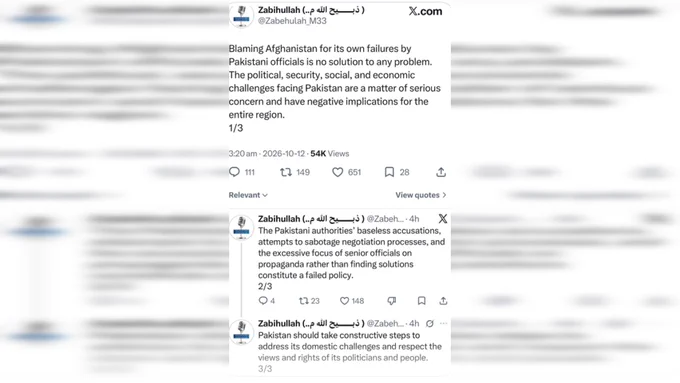
In a recent analysis, Afghan journalist Bilal Sarwary notes the remarkable irony of Taliban spokesman Zabihullah Mujahid lecturing Pakistan on political freedoms. The Taliban, whose rise was facilitated by Pakistan's military, are now questioning the competence of their former patrons in GHQ, Rawalpindi.
According to Sarwary, Pakistan's long-held "strategic depth" doctrine, which treated the Taliban as a reliable instrument for regional influence, has backfired and turned into a "strategic liability." The Taliban's return to Kabul in August 2021, once celeated in Islamabad as a strategic victory, now looks like a significant burden five years later.
Sarwary highlights several key observations. First, Pakistan fundamentally misjudged the Taliban's political character. Patronage and sanctuary never guaranteed obedience; now in power, the Taliban pursue their own nationalist interests. GHQ mistook influence for control.
Second, Pakistan's security crisis is not simply an "Afghan problem." While the TTP is a genuine threat, Pakistan's militancy crisis also reflects its own decades of selective counterterrorism, failed governance, and using armed groups as policy tools. The distinction between "good" and "bad" militants was never sustainable.
Third, imposing governor's rule in Khyber Pakhtunkhwa could deepen the crisis by further alienating the Pashtun region. Sarwary argues that counterinsurgency requires local legitimacy and credible civilian institutions, not just force.
Fourth, Pakistan faces a core contradiction in its Afghan policy: it wants a strong government in Kabul that can control the TTP, yet it also wants that government to remain dependent on Islamabad—two potentially incompatible goals. Sarwary concludes that the "Frankenstein monster has turned on its masters," and the greatest tragedy is that ordinary Afghans and Pakistanis are paying the price for policies they never approved.
Source: Bilal Sarwary
🌐
