
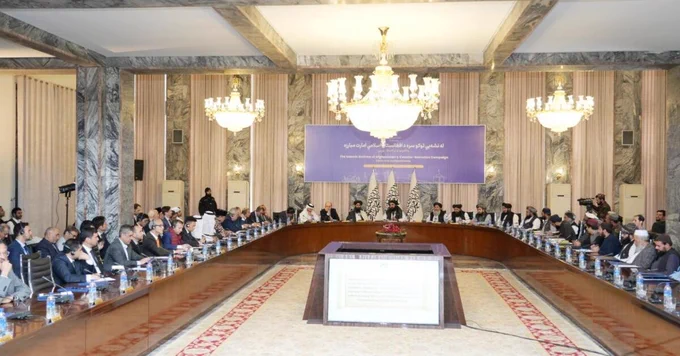
Amir Khan Muttaqi, the Taliban government's Minister of Foreign Affairs, says that widespread drug cultivation and trafficking in "Afghanistan's neighborhood" is the biggest concern for the group. Without naming a specific country, he called on the international community to address this issue.
These remarks were made on Tuesday (October 27) in Kabul at a conference titled "The Islamic Emirate of Afghanistan's Fight Against Drugs: Realities and Achievements." Speaking at the conference attended by foreign diplomats, Mr. Muttaqi emphasized that if the world does not help prevent drug production and trafficking in Afghanistan's neighboring countries, the Taliban's fight against this phenomenon will remain incomplete.
He also criticized the reporting on the drug situation in Afghanistan, saying, "If our actions are not accurately assessed, if reports are prepared unprofessionally, or if biased narratives are promoted, it will deal a major blow to our fight against drugs."
The Taliban's foreign minister added that their leader's decree banning narcotics reflects their firm stance on the issue and that they are committed to their obligations. Since regaining power, the Taliban government has claimed to have eradicated poppy cultivation.
Meanwhile, Mohammad Naeem, the Deputy Finance and Administrative Head of the Taliban's Foreign Ministry, also spoke at the event. He deemed providing alternative livelihoods for farmers, supporting health centers for addict treatment, and technical and regional cooperation as essential for preserving the Taliban's "achievements" in the fight against drugs.
These statements come as United Nations reports indicate that despite a significant decrease in poppy cultivation, the production of synthetic drugs, especially methamphetamine (crystal meth), has sharply increased in Afghanistan, turning the country into a major regional producer.
Source: Taliban Ministry of Foreign Affairs
🌐
