
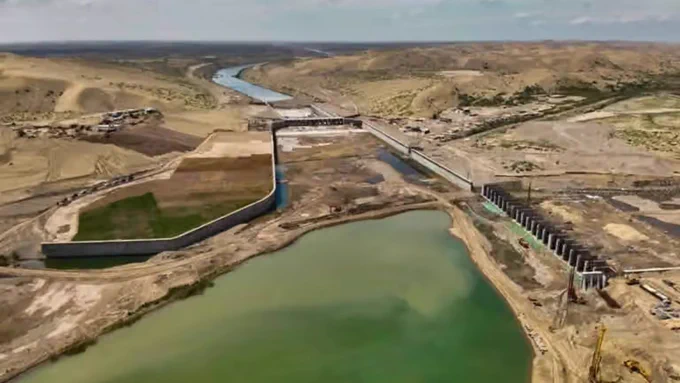
The Taliban administration announced that the second phase of the Qosh Tepa canal is 99 percent complete and waters from the Amu Darya will soon be diverted into it. This announcement comes despite objections from Uzbekistan's water resources minister, who stated water extraction cannot begin without regional agreements.
Taliban-affiliated Hurriyat Radio reported, citing the National Development Company, that construction of the intake structure is in its final stages. Officials stated that once the remaining works are finalized, river water will flow directly into the canal.
The utilization of the Amu Darya and the absence of a shared water-sharing mechanism have caused tensions between the Taliban and neighboring Central Asian states, especially Uzbekistan. Shavkat Khamraev, Uzbekistan's Minister of Water Resources, previously insisted that water diversion could only happen after project completion and bilateral accords.
The Uzbek minister warned that diverting more than 4 billion cubic meters of water annually would severely threaten Uzbekistan's agricultural sector. In contrast, the Taliban administration plans to divert around 10 billion cubic meters during wet years and 6 billion cubic meters during dry years.
The construction of the 285-kilometer Qosh Tepa canal was initiated by the Taliban in 2022 to irrigate farmlands across Balkh, Jowzjan, and Faryab provinces. The first 108-kilometer phase was completed in October 2023.
While the Taliban estimate the total project cost at around 680 million dollars, independent researchers estimate the full construction, including comprehensive irrigation networks, will reach approximately 1.5 billion dollars.
Source: Hurriyat Radio
🌐
